
Exam Review Lab 05 —Exam-day basics & timing
Paper-by-paper timing plan · answer-sheet practice · what examiners reward · pacing drills. Revision only · recycles Module 01 — no new language.
PET parts in this lesson · mixed-skill spiral
Why this lesson now? Exam-focus hour attached to Module 01.
CEFR Pathway · You are here
Exam Boost · Performance Session
A progress checkpoint, not a test.
Recycle this phase's language through challenges, mini-tasks and longer speaking turns. Aim for fluency, not perfection — replay anything, skip nothing.
Get ready · 01
5 minGet talking — no pressure
What time do you usually get up on an exam day compared to a normal day? Why?
How long do you think the PET Reading and Writing paper lasts? Guess in minutes.
Are you usually calm or nervous before a test? What do you normally do to feel ready?
Grammar recap · 02
8–10 minTalking about routines and plans (Module 1 recycle)
Present simple = routines and facts. Present continuous = plans already arranged.
On exam day, students describe two kinds of things: what usually happens (present simple — 'I usually check my pencil case the night before') and what is already arranged for that specific day (present continuous — 'I'm arriving at the exam centre at 8.30'). This lab only uses Module 1 grammar, so students can focus on exam facts, not new grammar.
→ I usually wake up early on test days.
→ I'm taking the exam next Saturday.
→ The Reading and Writing paper usually takes an hour and thirty minutes.
→ I always check my bag the night before, because I don't want to forget my ID.
→ This year, the exam starts at nine o'clock.
Challenge 1.I ___ my bag the night before an exam.
Challenge 2.I ___ the exam next Saturday morning.
Challenge 3.The Listening paper ___ about 30 minutes.
Challenge 4.I ___ arrive early, so I don't feel rushed.
Challenge 5.This year the exam ___ at 9am.
Build the sentence → spot the natural chunks → say it aloud → reply like a real conversation.
1.Rebuild the sentence — then say it aloud.
2.Rebuild the sentence — then say it aloud.
3.Rebuild the sentence — then say it aloud.
Quick check 1.Which sentence describes a general routine?
Quick check 2.Which sentence describes something already arranged?
Vocabulary recap · 03
5–7 minRecycle your toolkit
to have a good relationship with someone
Who do you get on with best in your family? Why?
'I'm originally from Lima.'
Say where you are originally from + where you live now.
'I study Tourism at a college in Madrid.'
Tell a partner what you study/do AND where.
What to do
- 1.Revision only — every phrase here comes from Module 1.
- 2.Match each one with its meaning.
Tap an item on the left, then tap its match on the right.
Activation · Personalise · Recycle
Reactivate Module 1 language out loud — nothing new here, just faster recall.
Ask your partner
- Say where YOU are based in one sentence.
- Who do you get on with best in your family? Why?
- Say no to an invitation using 'unfortunately'.
"Say where you are originally from + where you live now."originally from
Which of these Module 1 phrases do you still forget under exam pressure? Why?
Write 25–35 words about your English progress using BOTH recycled phrases.
Pronunciation polish · 04
3–4 minNumbers and times, said clearly
Say exam times slowly and clearly: 'nine o'clock', 'half past nine', 'ninety minutes'.
- • The exam starts at nine o'clock.
- • The Reading and Writing paper lasts ninety minutes.
- • You have thirty minutes for the Listening paper.
- • Question number fifteen is on page four.
Reading challenge · 05
8–10 minPET Reading Part 3 — A calm start to exam day
Many students think exam success starts in the exam room. Actually, it usually starts the night before. Teachers often give the same simple advice: pack your bag early, check you have your ID, and go to bed at your usual time.
On the morning of the exam, it helps to eat a normal breakfast and arrive early — not too early, just early enough to feel calm. Once you are in the exam room, listen carefully to the instructions. The person in charge always explains how to fill in the answer sheet, and this is important information, not just a formality.
During the exam, the most useful habit is simple: never leave a question blank. An empty answer always gets zero marks, but a guess sometimes gets marks. So even when you are not sure, write something. On the whole, calm preparation and a clear plan for each paper matter more than last-minute revision.
Challenge 1.According to the text, when does exam success often start?
Challenge 2.What does the text say about the answer sheet instructions?
Challenge 3.What is the text's main advice about unsure answers?
Q1.The text says exam success only starts in the exam room.
Q2.The text recommends eating a normal breakfast.
Q3.The text says an empty answer always gets zero marks.
What to do
PET Reading Part 1 — Read each notice and choose A, B or C. ~5 minutes.
EXAM ROOM 3
Please arrive 15 minutes before the start time. No mobile phones inside the room.
1.What must students do?
Write your candidate number on every answer sheet. Use a pencil, not a pen.
2.What does the sign tell candidates?
3.What does the message remind students to bring?
TIMING
Reading and Writing: 1 hour 30 minutes. Listening: about 30 minutes. Speaking: 10–12 minutes per pair.
4.How long is the Reading and Writing paper?
5.What should students do first?
Listening challenge · 06
8–10 minPET Listening Part 2 — Two students before the exam (2-min dialogue)
Listening audio
Tap play to listen. Replay as many times as you need.
Show transcript
Leo:Are you ready for the exam tomorrow?
Emma:I think so. I always pack my bag the night before, so I'm not rushing in the morning.
Leo:Good idea. What time does it start again?
Emma:Nine o'clock. The Reading and Writing paper lasts ninety minutes, and then we have a short break before Listening.
Leo:And how long is Listening?
Emma:About thirty minutes, I think. My teacher says the most important thing is to never leave a question blank — always write something, even if you're not sure.
Leo:That's good advice. I usually check my work at the end if I have time.
Emma:Same here. I also make sure I fill in the answer sheet carefully, because that's where the marks actually come from.
Challenge 1.What does Emma always do the night before an exam?
Challenge 2.How long does the Reading and Writing paper last?
Challenge 3.What does Emma's teacher say is most important?
What to do
Tick every exam word or phrase you hear in the dialogue.
Skills challenge · 07
5 minPaper-by-paper time management
Know the shape before the day: Reading & Writing 90 min, Listening ~30 min, Speaking 10–12 min per pair.
Task
PET has three papers. Students who know the timing in advance feel calmer and pace themselves better. This drill builds a simple mental clock for each paper.
Example
Reading & Writing = 90 minutes for several parts. If one part is taking too long, move on and come back at the end — don't run out of time on the last part.
Writing challenge · 08
5 minShow what you can do
Q1.Type ONE word: 'The exam ___ at nine o'clock.'
Q2.Type ONE word: 'I always pack my bag the night ___.'
Q3.Type ONE word: 'Please fill ___ your candidate number.'
Q4.Type ONE word: 'Never leave a question ___.'
PET Writing Part 2 (article, ≈80–100 words, Module 1 language only). Prompt: 'Describe your usual morning routine, and say how it would change on exam day.' Use present simple for routines and present continuous for the exam-day plan.
Your writing draft
0 words SavedShow model answer & examiner comment
On a normal day, I usually get up at seven and eat breakfast quickly before school. On exam day, though, my morning is a little different. I'm getting up earlier, at half past six, because I don't want to feel rushed. I always check my pencil case and my ID card before I leave, and this time I'm also checking my bag twice. My mum is driving me to the exam centre instead of walking, because it starts at nine o'clock and I want to arrive early and feel calm.
Examiner comment
| 5 | All content points covered; consistent style; range of structures; minor errors only. |
| 3 | Content mostly covered; mostly suitable style; some range; errors don't stop the reader understanding. |
| 1 | Limited content; intrusive errors; very basic structures; under-length. |
What to do
- 1.PET Writing Part 1 — Reply to this email in about 80–100 words.
- 2.Cover ALL four notes.
- 3.Use Module 1 language only.
Hi! I heard we have the exam tomorrow morning. What time do you usually get up? What do you always pack in your bag before a test? Are you nervous? And what time shall we meet outside the exam centre? Alex
Your reply must cover:
- Give a specific time for getting up
- Name at least one thing you always pack
- Say honestly how you feel, with a reason
- Suggest a clear meeting time
Show model answer
Hi Alex, yes, it's tomorrow! I usually get up at seven, but tomorrow I'm getting up at half past six so I don't feel rushed. I always pack two pencils, my ID card and a bottle of water — I check my bag the night before. To be honest, I'm a little nervous, but I always feel better once the exam starts. Shall we meet outside the exam centre at half past eight? That gives us time before the doors open. See you tomorrow! Sam
Communication lab · 09
10–15 minTalk it out
PET Speaking Part 4 — In pairs, take 3 minutes total. Question: 'What do you usually do to prepare for an exam?' Use present simple for routines and 'because' or 'so' to give reasons.
Useful phrases
What to do
Choose the most natural Speaking Part 1 / 4 answer.
- ExaminerWhat do you usually do the night before an exam?
- Candidate_______________
- ExaminerHow do you feel before an exam?
- Candidate_______________
What to do
- 1.PET Speaking Part 1 — examiner-led interview (~2 minutes per candidate).
- 2.Short, natural answers using Module 1 grammar and vocabulary.
Phase 1 — short factual questions
1.Examiner: "What's your name?"
2.Examiner: "Where do you go to school?"
Tip: Add one detail — the town, or how long you've been there.
3.Examiner: "What time do you usually get up?"
Tip: Give a time, then a reason.
4.Examiner: "What did you do last weekend?"
Tip: Use past simple, then 'because' or 'and'.
Phase 2 — extended question (aim for 3–5 sentences)
Examiner: "Tell me about how you prepare for a test."
Tip: Aim for 20–30 seconds. What do you do the night before? What do you do on the day?
Show model extended answer
The night before a test, I always pack my bag early and check I have everything — pencils, my ID card and a bottle of water. I usually go to bed at my normal time, because I don't like feeling tired. On the morning of the test, I eat a normal breakfast and I try to arrive early, so I feel calm before it starts.
What to do
- 1.PET Speaking Part 2 — 1 minute per candidate.
- 2.Describe the photo, then say what's probably happening.
- 3.Use present continuous and 'It looks as if…'.

Candidate A — Checking the time while studying
Need help? Show prompts (try describing with no help first)
- • What can you see?
- • What is the person doing?
- • Why might they be checking the time?
- • How do they look?
- • Do you check the time when you study?
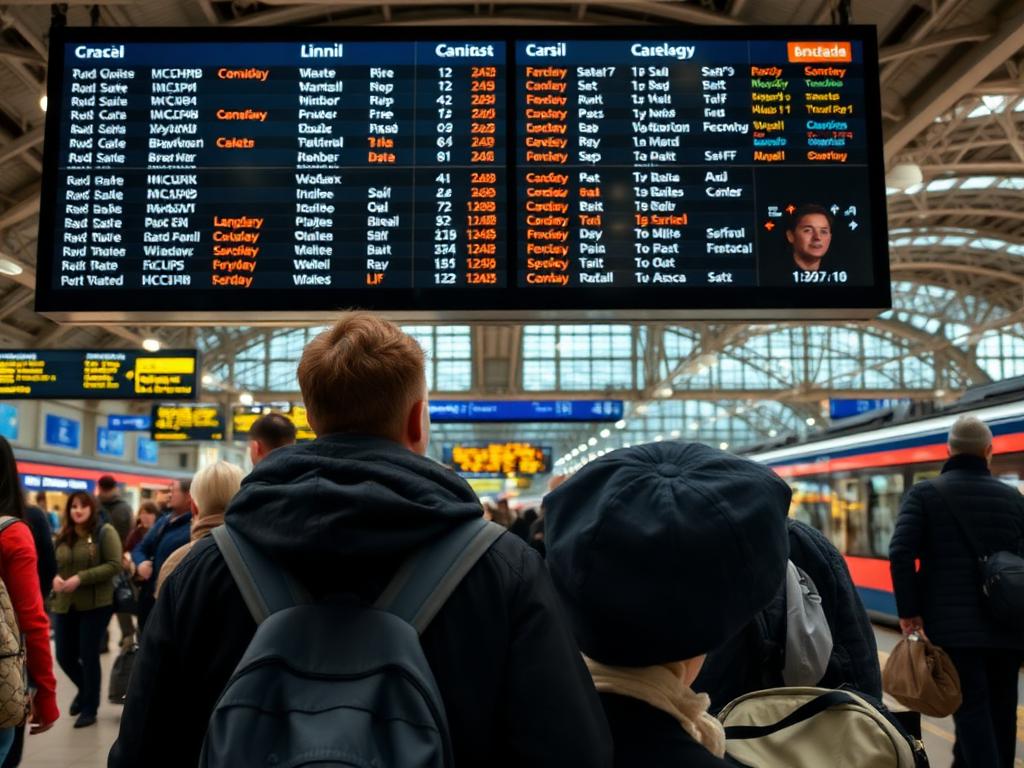
Candidate B — Reading a departures board
Need help? Show prompts (try describing with no help first)
- • What can you see?
- • Where are these people?
- • What are they probably looking for?
- • How do they feel?
- • Have you ever waited for a train or bus?
Useful phrases
- • In the photo I can see…
- • It looks as if…
- • They seem to be…
- • I think they're probably…
- • In the background…
Show model 1-minute description
In the first photo I can see a person sitting at a desk with books and a clock. They're looking at the time, so it looks as if they're checking how long they have left to study. They seem quite focused, and I think they're probably preparing for a test, a bit like we do before an exam.
Optional · Teacher-led
Teacher Activities
Run this lab as a calm, practical briefing — the goal is confidence, not stress. Use real times from the students' own upcoming exam if you know them. ~36 min total
Keep it going · 10
Take-homeExtend it at home
Self-study — everything you need is included below. All four skills are covered so you keep the spiral going between lessons; pick the order that suits you.
Timing plan — write your own exam-day timetable for a normal exam morning.
Your response
0 words SavedMaterials included
Task
Attempt the task first, then check your answers.
PET Reading Part 1 mock — re-do the 5-item notices task from this lesson in 5 minutes.
Your response
0 words SavedMaterials included
Task
Attempt the task first, then check your answers.
PET Writing Part 1 mock — reply to the email below in 80–100 words. Cover all four notes.
Your response
0 words SavedMaterials included
Stimulus email
4 notes
Attempt the task first, then check your answers.
Listening recycling drill — read the Leo/Emma dialogue aloud twice. Tick every exam word you hear.
Your response
0 words SavedMaterials included
Dialogue
Tick if you hear it
Attempt the task first, then check your answers.
Wrap-up · 11
2–3 minWhat you can now do
- Know the shape of the exam: Reading & Writing 90 min, Listening ~30 min, Speaking 10–12 min per pair.
- Present simple = routines. Present continuous = plans for exam day.
- Never leave a question blank — a guess can get marks, a blank never can.
- Fill in the answer sheet carefully — that's where marks actually come from.
- Arrive early and pack the night before to feel calm, not rushed.
- Check your work at the end if there's time left.
Need more practice?
Optional · your lesson progress stays the sameShort notices and messages
Practise this exam skill
Numbers, times and spelling
Practise this exam skill
Matching people to texts
Practise this exam skill