
Module 02 —Telling a Story
Writing Part 2 story · past simple vs past continuous · sequencing language
PET parts in this lesson · mixed-skill spiral
Why this lesson now? Builds on the Writing 2 story introduced in Lesson 02.
CEFR Pathway · You are here
Get ready · 01
5 minGet talking
Your teacher reads: 'It was raining when Ana left the house.' In pairs, guess what happens next — you have 30 seconds.
'The sun was shining' vs 'The car stopped'. Which sentence describes the background, and which describes something that happened?
Think of a film you like. Can you sum up the beginning, middle and end in three sentences?
Grammar for the Exam · 02
8–10 minPast simple vs past continuous
Past continuous = the background scene (was/were + -ing). Past simple = the events that happened, one after another.
PET Writing Part 2 stories are marked partly on how well you control narrative tenses. Use the past continuous to set the scene or describe an action already in progress — it paints the background of your story: 'It was raining', 'She was waiting for the bus'. Use the past simple for the events that move the story forward — the things that happened one after another: 'she opened her umbrella', 'the bus arrived'. The two often combine in one sentence, with the continuous as the background and the simple past as the interruption: 'While she was waiting, she noticed a strange bag on the seat.' This single sentence pattern is one of the highest-scoring structures in a PET story.
→ It was snowing heavily when the train finally arrived.
→ While I was walking home, I saw an old friend from school.
→ She was reading a magazine when her phone suddenly rang.
Question 1.'While Tom ____ dinner, the phone ____.'
Question 2.Which sentence describes the BACKGROUND of a story?
Question 3.'I ____ home when I ____ the accident.'
Question 4.Choose the correct sequence of EVENTS (past simple).
Question 5.'They ____ for the bus when it started to pour with rain.'
Quick check 1.In a PET story, the past continuous is mainly used for…
Exam Vocabulary · 03
5–7 minWords & phrases to own
exactly at that time in the story
Use 'at that moment' to link two events in a story.
finally, as the last result of a situation
Tell a short story ending with 'in the end'.
suddenly, with no sign beforehand
Use 'without warning' in a sentence about the weather.
to suddenly start laughing loudly
Describe a time someone burst out laughing.
Activation · Personalise · Recycle
Use the sequencing words to link real or invented events — the examiner rewards range of linkers, not just correct tenses.
Ask your partner
- Tell your partner about a time something happened suddenly.
- Describe what you were doing at that moment.
- What eventually happened?
"Without warning, …"without warning
Do you think it's better to plan a story carefully, or just start writing and see what happens 'in the end'?
Give your answer + one reason.
Write 40 words continuing this line: 'It was a normal Tuesday morning until…'
Pronunciation for Speaking · 04
3–4 minSentence stress on time linkers
Sequencing words like 'suddenly' and 'eventually' carry strong stress — they signal a turning point in the story.
- • SUDDENly, the door opened.
- • At THAT moment, everyone turned around.
- • EVENTually, she found her keys.
- • In the END, they missed the train.
Reading Skills · 05
8–10 minReading — how a good story is built
A good short story does not need a complicated plot. What it needs is a clear shape: a calm beginning, a problem in the middle, and a clear ending. Readers — and PET examiners — quickly lose interest in a story that jumps around without warning.
Most successful PET stories follow the same pattern. The first sentence, which is often given to you, sets the scene: where the character is and what they are doing. The past continuous does most of this work — 'Maria was walking home from work' tells us the background before anything interesting has happened yet.
Then something changes. This is the moment the past simple takes over: 'she noticed', 'the phone rang', 'a car stopped beside her'. Sequencing words like 'suddenly' or 'at that moment' tell the reader that the calm background has been interrupted.
Finally, every story needs a clear ending, even a short one. 'In the end' and 'eventually' are useful signals that the story is finishing. Writers who forget to write an ending — and simply stop — lose marks, because the reader is left wondering what happened.
Question 1.According to the text, what shape does a good story need?
Question 2.What is the past continuous mainly used for in the first sentence?
Question 3.What do words like 'suddenly' signal?
Question 4.What mistake do some writers make with endings?
Listening Skills · 06
8–10 minListening — retelling a strange evening
Listening audio
Tap play to listen. Replay as many times as you need.
Show transcript
Narrator:Priya is telling her friend Callum about something odd that happened last night.
Priya:So, last night I was walking home from the cinema, quite late, when I heard this strange noise behind me.
Callum:What kind of noise?
Priya:Like footsteps, but really quiet. I was getting a bit nervous, to be honest, so I stopped and turned round.
Callum:And? Was someone there?
Priya:No one at all! Just an empty street. So I kept walking, and then, suddenly, a cat jumped out from behind a bin.
Callum:A cat! That's what was making the noise?
Priya:Exactly. I burst out laughing at myself. But then, while I was still laughing, my phone rang and I nearly dropped it in the road!
Callum:Who was it?
Priya:Just my mum, checking I was okay. In the end, it was a completely normal walk home, but for about two minutes I was properly scared.
Question 1.What was Priya doing when she heard the noise?
Question 2.What was actually making the noise?
Question 3.What happened while Priya was laughing?
Question 4.Who was calling Priya?
What to do
Tick the expressions you actually hear.
Exam Strategy · 07
5 minWriting Part 2 — the story task
Background (continuous) → events (simple + linkers) → ending signal.
Task
You are given a first sentence and must continue the story in about 100 words.
Example
Given: 'Jack was walking his dog in the park when something unusual happened.' Continuation: He was walking his dog in the park when he noticed a small wallet on the ground. He picked it up and looked inside — there was no name, only some money. Suddenly, an old man ran up, looking worried. Jack gave him the wallet, and the man was so grateful that he invited Jack for a coffee. In the end, they became good friends.
Writing Task · 08
5 minPut it in writing
Q1.Combine: 'She / walk / to school' (background) + 'she / see / an accident' (event).
Q2.Add a sequencing word: '____, the whole class stopped talking.'
Writing Part 2 — Continue this story in about 100 words: 'It was a quiet Saturday afternoon when Leo's phone suddenly rang.' Use at least two past continuous verbs and two sequencing words.
Your writing draft
0 words SavedShow model answer & examiner comment
It was a quiet Saturday afternoon when Leo's phone suddenly rang. He was tidying his room and almost didn't answer it. It was his cousin, Ella, calling from the airport — her flight had landed early and no one was there to collect her. Leo was still wearing his old pyjamas, but he grabbed his keys and ran outside anyway. While he was driving to the airport, it started to rain heavily. Eventually he found her, tired but smiling, waiting by the entrance. In the end, they had a great afternoon together, even though it started in such a rush.
Examiner comment
| 5 | All content points covered; consistent style; range of structures; minor errors only. |
| 3 | Content mostly covered; mostly suitable style; some range; errors don't stop the reader understanding. |
| 1 | Limited content; intrusive errors; very basic structures; under-length. |
Speaking Task · 09
10–15 minMake it a real conversation
In pairs, tell each other a short true story about something surprising that happened to you or someone you know. Your partner must ask one follow-up question using a past tense.
What to do
- 1.Speaking Part 2 — describe your photograph for about a minute.
- 2.Say what you can see and imagine what might happen next, like the start of a story.
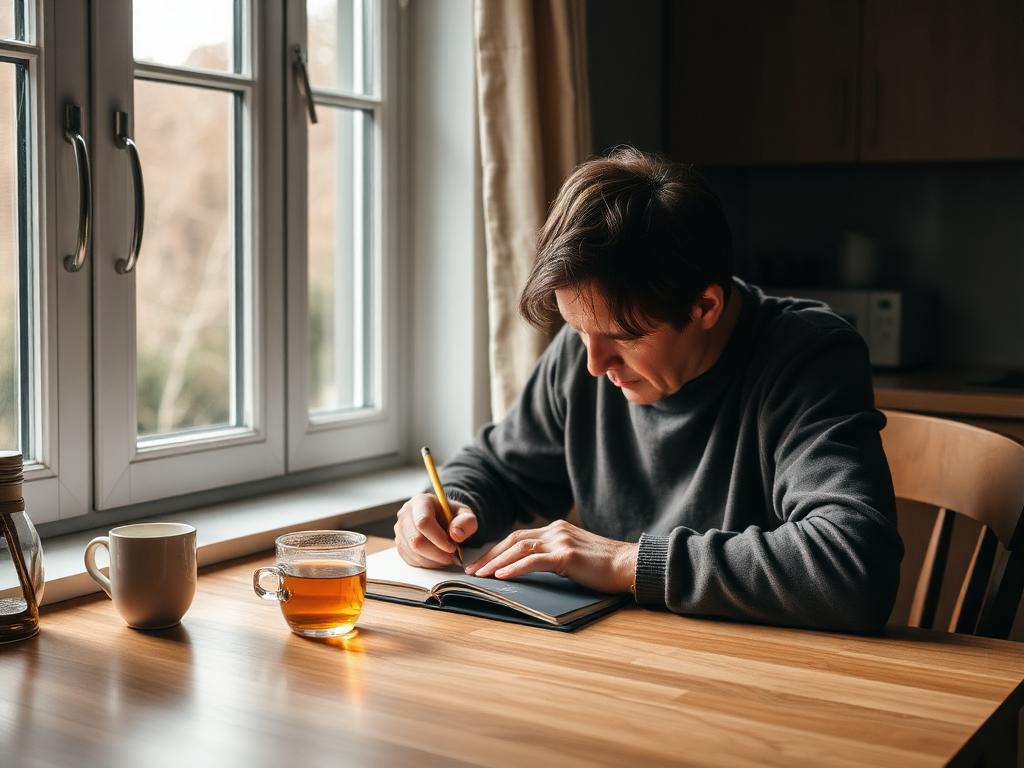
Candidate A — Writing at the kitchen table
Need help? Show prompts (try describing with no help first)
- • What can you see?
- • What is the person doing?
- • How do they seem to feel?
- • What do you think they are writing about?

Candidate B — Waiting in the rain
Need help? Show prompts (try describing with no help first)
- • What can you see?
- • Where do you think this is?
- • How does the weather affect the mood of the photo?
- • What might happen next?
Useful phrases
- • In the photo I can see…
- • It looks like…
- • The person seems to be…
- • In the background, there's…
Show model 1-minute description
In the photo I can see someone sitting at a kitchen table, writing in a notebook. It looks like early morning because there's a cup of coffee next to them. They seem quite relaxed, maybe writing a diary or planning something. In the background, there's a window with soft light coming through.
Optional · Teacher-led
Teacher Activities
Use these if the writing task finishes early. ~14 min total
Homework · 10
Take-homeTake it home
Self-study — everything you need is included below. All four skills are covered so you keep the spiral going between lessons; pick the order that suits you.
Write a full PET Writing Part 2 story (about 100 words) continuing the given first sentence. Use the checklist to self-mark.
Your response
0 words SavedMaterials included
First sentence
Checklist
Attempt the task first, then check your answers.
Rewrite these sentences, choosing the correct past simple / past continuous form.
Your response
0 words SavedMaterials included
Sentences
Attempt the task first, then check your answers.
Listening review: rewrite Priya's story from the lesson as a short written narrative (60–80 words), using at least one sequencing word.
Your response
0 words SavedMaterials included
Reminder of the story
Attempt the task first, then check your answers.
Recap · 11
2–3 minWhat you've learned
- Past continuous sets the background; past simple carries the events forward.
- Sequencing words (suddenly, at that moment, eventually, in the end) organise a story and signal turning points.
- PET Writing Part 2 stories score higher with a clear three-part shape: background, events, ending.
- New vocabulary to reuse: suddenly, at that moment, eventually, to realise, in the end.
Need more practice?
Optional · your lesson progress stays the sameTelling a story in the past
Practise this exam skill
Words that get confused
Practise this exam skill
Fix the common mistake
Practise this exam skill