
Exam Review Lab 03 —Linking + cloze
Mixed practice across R-P4 · R-P5 · L-P1 · S-P1 · S-P3 · W-P1 — under exam timing. Revision only · recycles Modules 06–07 — no new language.
PET parts in this lesson · mixed-skill spiral
Why this lesson now? Third spiral checkpoint — gapped text and cloze return under exam timing.
CEFR Pathway · You are here
Exam Boost · Performance Session
A progress checkpoint, not a test.
Recycle this phase's language through challenges, mini-tasks and longer speaking turns. Aim for fluency, not perfection — replay anything, skip nothing.
Get ready · 01
5 minGet talking — no pressure
Which is easier for you now: choosing the right sentence for a gap, or choosing the right word? Why?
Read any short paragraph and blank out 3 words. Swap with a partner and try to guess them from context.
In your last text message, find one word that refers back to something (it, this, that, they). What does it refer to?
Grammar recap · 02
8–10 minLinkers + reference words (Modules 6–7)
Linkers glue clauses. Reference words (it, this, that, they, one) glue whole sentences. Both are tested in Reading 4 and 6.
Modules 6–7 built up linking — the invisible grammar that holds texts together. Reading 4 tests whole-sentence linking (which sentence fits the gap?). Reading 5 tests word partner. Reading 6 tests grammar words (auxiliaries, articles, prepositions).
→ I bought a jacket. It was on sale. (it = the jacket)
→ The café was full, so we went home. (so = result)
→ Some students prefer mornings; others work best late. (others = other students)
→ This is the reason we're late. (this = the whole previous sentence)
→ I love oranges, but bananas are cheaper. (contrast)
Challenge 1.I've lost my keys. ___ must be in the car.
Challenge 2.The film was long, ___ we still enjoyed it.
Challenge 3.Some people prefer tea; ___ prefer coffee.
Challenge 4.I couldn't sleep. ___ is why I'm tired now.
Challenge 5.I bought a coat and a scarf. The ___ was on sale.
Build the sentence → spot the natural chunks → say it aloud → reply like a real conversation.
1.Rebuild the sentence — then say it aloud.
2.Rebuild the sentence — then say it aloud.
3.Rebuild the sentence — then say it aloud.
Quick check 1.Which word BEST links contrast?
Quick check 2.In 'I bought two books. One was a novel.', what does 'One' refer to?
Vocabulary recap · 03
5–7 minRecycle your toolkit
used to explain why something happens, referring back
Complete: 'The road was closed. For this reason, ____.'
skilled / not skilled at something
What are you good at and what are you bad at?
to reduce the number of possible answers
How do you narrow down your choices in a difficult question?
used to introduce a surprising fact learned later
Tell a short story using 'it turns out'.
What to do
- 1.Revision only — every phrase here comes from Modules 6–7.
- 2.Match each one with its meaning.
Tap an item on the left, then tap its match on the right.
What to do
Sort the recycled phrases by the module where you first met them.
Activation · Personalise · Recycle
Reactivate Modules 6–7 language out loud — nothing new here, just faster recall.
Ask your partner
- Finish: 'I love coffee. However…'
- Tell me one decision you made this week.
- Complete: 'The road was closed. For this reason, ____.'
"What are you good at and what are you bad at?"good at / bad at
Which of these Modules 6–7 phrases do you still forget under exam pressure? Why?
Write 25–35 words about your English progress using BOTH recycled phrases.
Pronunciation polish · 04
3–4 minWeak forms in linkers
In fluent speech, 'as a result', 'for example', 'have to' shrink — the vowels weaken to /ə/.
- • azza-result, I stayed at home.
- • for-example, I ended up cooking.
- • on top-of-that, I forgot my keys.
- • I hafta admit, it was worth it.
Reading challenge · 05
8–10 minPET Reading Part 4 — Learning a language the slow way
Most people who try to learn a new language do the same thing: they buy an app, they promise themselves fifteen minutes a day, and they stop after three weeks. I did exactly that with Portuguese for years.
What finally worked wasn't a better app. [[1]] Once I stopped trying to learn 'a language' and started trying to have one specific conversation — ordering coffee, asking for directions, complimenting my neighbour's dog — everything changed. I had a real reason to remember the words.
[[2]] They were short, boring and, honestly, a bit humiliating. But every one of them ended with the other person understanding me. That was addictive. On top of that, my neighbour started saying hello first, which I still remember as the single best moment of my first six months.
[[3]] It's tempting to switch to English the moment a conversation gets slow. Resist it. The awkward silence is where the learning is — you either search for the word you need or you rewording, and both build real memory in a way flashcards never do.
As a result, my Portuguese is nothing like fluent. [[4]] What it is, though, is USABLE — I can spend a weekend in Lisbon without switching to English once, and that was the goal all along.
[[5]] That, in the end, was the lesson I wish someone had told me on day one.
Challenge 1.What is the writer's main point about learning a language?
Challenge 2.How does the writer feel about switching to English?
Challenge 3.What is the writer's honest view of their own Portuguese?
What to do
- 1.PET Reading Part 4 — Choose the sentence (A–H) that fits each gap.
- 2.THREE sentences are extra.
Read the text about learning a language. Five sentences have been removed. Match one sentence to each gap.
Sentence options
Listening challenge · 06
8–10 minPET Listening Part 1 — Five very short exchanges (choose A / B / C)
Listening audio
Tap play to listen. Replay as many times as you need.
Show transcript
Narrator:Where did the woman spend her weekend?
Woman:I was supposed to go to the coast, but my sister asked me to help her move, so I ended up in Manchester for two days. Never made it near the beach.
Narrator:What is the man's job now?
Man:I trained as an architect, and I worked in a design studio for years. But last summer I retrained, and I've been teaching maths at a secondary school ever since.
Narrator:What does the woman recommend?
Woman:The pasta was fine, but honestly — go for the fish. It's what everyone orders, and there's a reason for that. The desserts you can skip.
Challenge 1.Where did the woman spend her weekend?
Challenge 2.What is the man's job now?
Challenge 3.What does the woman recommend?
What to do
Tick every recycled linker you hear across the three short exchanges.
Skills challenge · 07
5 minReading 4 (gapped text) speed
Read gap-out. Read the sentence BEFORE and the sentence AFTER each gap. The right option agrees with both.
Task
Reading Part 4 is a linking test, not a content test. The right sentence must (a) match the tense, (b) share a topic word, and (c) not clash with the sentence AFTER the gap. Tempting wrong answers usually fail on that third check.
Example
Gap [[3]]: previous sentence sets up 'the hardest habit to break'. Option C names it. Option F names something else — clash. Commit to C.
Writing challenge · 08
5 minShow what you can do
Q1.Type ONE word (PET Reading 6 style): 'I've been learning Portuguese ___ two years.'
Q2.Type ONE word: 'It's the best café ___ town.'
Q3.Type ONE word: 'She's really good ___ languages.'
Q4.Type ONE word: 'I don't know ___ they arrived.'
PET Writing Part 2 (article, ≈100 words). Prompt: 'What's the best way to learn a new skill?' Use at least TWO recycled linkers (as a result, on top of that, having said that, for example).
Your writing draft
0 words SavedShow model answer & examiner comment
The best way to learn a new skill, on the whole, is to have a small, embarrassing goal you can practise in public. For example, when I started Portuguese, I set myself the goal of ordering coffee without switching to English. It sounds tiny, but as a result I remembered the vocabulary for weeks. On top of that, the barista started to recognise me. Having said that, apps and grammar books still help — I just don't rely on them alone. Real practice, however small, beats perfect preparation every single time.
Examiner comment
| 5 | All content points covered; consistent style; range of structures; minor errors only. |
| 3 | Content mostly covered; mostly suitable style; some range; errors don't stop the reader understanding. |
| 1 | Limited content; intrusive errors; very basic structures; under-length. |
What to do
- 1.PET Writing Part 1 — Reply to Sam's email in about 100 words.
- 2.Cover ALL 4 notes.
Hi! I've decided I want to learn something new this year but I can't decide what. I know you've picked up a few new hobbies recently, so — could you tell me what you'd recommend? How long did it take before you got any good? What's the hardest part? And is there anything I should NOT do at the start? Cheers, Sam
Your reply must cover:
- Recommend one specific hobby (not just 'try something')
- Give a rough timeframe (weeks / months)
- Describe the hardest part honestly
- Give a clear ONE thing not to do at the start
Show model answer
Hi Sam! Great news — you'll love this. I'd honestly recommend cooking, especially bread. It took me about two months of weekly Saturdays before mine stopped looking like bricks, so don't panic if the first three tries are terrible. The hardest part isn't the recipe — it's being patient enough to wait for the dough to rise; I still get that wrong sometimes. And if there's ONE thing I'd tell you not to do, it's don't buy expensive kit at the start. Use what you have. Let me know what you pick! Talk soon, Alex
Communication lab · 09
10–15 minTalk it out
PET Speaking Part 3 — discussion task (in pairs, ~3 minutes). Look at the visual prompt of relaxing activities and decide together which TWO are the best ways to relax after work or study.
Examiner
"Here are some ways to relax after work or study. Talk together about how good each one is, and then decide which TWO are the best."
Talk together about
Which TWO are the BEST ways to relax after work / study?
Share opinions, agree and disagree — you do not have to talk only about yourself.
Ideas you could discuss
- A walk in the park
- Cooking a meal
- Watching a series
- Going to the gym
- Reading a book
Round off the discussion
Now decide together: which TWO would you choose, and why?
Useful discussion language
What to do
Choose the most natural Speaking Part 3 turn.
- AWhat do you think about going to the gym after work?
- B_______________
- ASo shall we go for a walk in the park and cooking?
- B_______________
What to do
- 1.PET Speaking Part 1 — examiner-led interview.
- 2.Practise extending phase-1 answers with ONE reason, and giving 25–35 seconds on phase-2.
Phase 1 — short factual questions
1.Examiner: "What do you enjoy doing in your free time?"
Tip: Name ONE hobby + when + who with.
2.Examiner: "How often do you use social media?"
Tip: Give a rough frequency + one honest opinion.
3.Examiner: "What did you do last weekend?"
Tip: Use past simple + 'because' or 'so'.
4.Examiner: "Do you prefer studying alone or with other people?"
Tip: Pick one and give ONE reason.
Phase 2 — extended question (aim for 3–5 sentences)
Examiner: "Tell me about a skill you'd like to learn."
Tip: 25–35 seconds: what, why, how you'd start, one specific first step.
Show model extended answer
I'd really like to learn to cook properly — not just pasta on a Tuesday, but real dishes with real technique. Mainly because I get tired of eating the same three things, and honestly cooking looks like a life skill I should have picked up already. As a first step I'd probably start with one Sunday recipe a week — nothing complicated — and on top of that watch one short video before shopping. Having said that, I'd need someone to eat it all with me, so I might invite a friend over.
What to do
- 1.Speaking Part 2 — 1 minute each.
- 2.Describe the photo, then say what is probably happening.
- 3.Use present continuous and 'It looks as if…'.
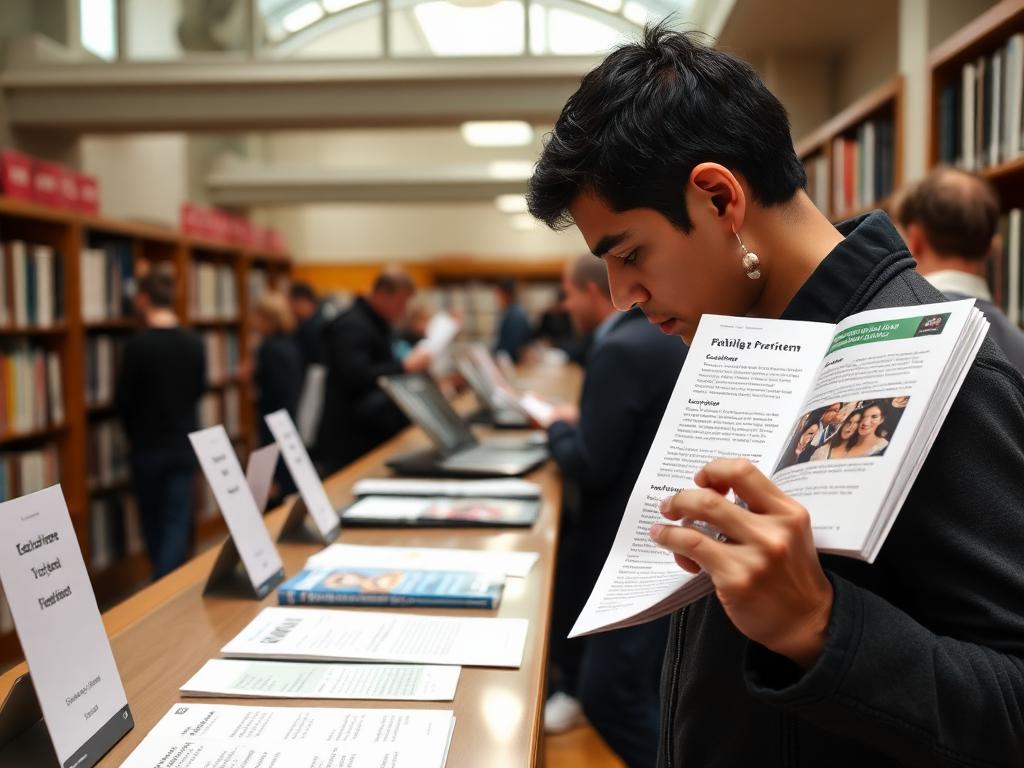
Candidate A — Reading information at a library
Need help? Show prompts (try describing with no help first)
- • What can you see?
- • Where is this person?
- • What are they reading?
- • How do they look?
- • When do you read information like this?

Candidate B — Studying together at home
Need help? Show prompts (try describing with no help first)
- • What can you see?
- • What are they doing?
- • Why are they working together?
- • How do they feel?
- • Do you prefer studying alone or with someone?
Useful phrases
- • In the photo I can see…
- • It looks as if…
- • They seem to be…
- • I think they're probably…
- • In the background…
Show model 1-minute description
In the first photo I can see a young man standing at a desk in a library. He's holding a leaflet and reading it carefully, so it looks as if he's checking some information — maybe opening times or a course. There are books and other people behind him, and he seems quite focused.
Optional · Teacher-led
Teacher Activities
Run this lab in three 20-minute blocks: Reading → Listening → Speaking/Writing. Emphasise that Reading 4 is a linking task, not a comprehension one. ~40 min total
Keep it going · 10
Take-homeExtend it at home
Self-study — everything you need is included below. All four skills are covered so you keep the spiral going between lessons; pick the order that suits you.
PET Reading Part 4 mock — re-do the gapped-text (5 gaps, 8 options) in 6 minutes. Note ONE tempting wrong answer you almost fell for.
Your response
0 words SavedMaterials included
Task
Tempting wrong answer log
PET Writing Part 1 mock — reply to Sam's email in 100 words. Cover all four notes.
Your response
0 words SavedMaterials included
Stimulus email
4 notes
Attempt the task first, then check your answers.
PET Speaking Part 1 mock — record a 30-second answer to 'Tell me about a skill you'd like to learn.' Use at least two linkers.
Your response
0 words SavedMaterials included
Prompt
Linkers to use (pick 2+)
Attempt the task first, then check your answers.
Listening linker-hunt — read the three short exchanges below aloud twice. Write down every linker you hear.
Your response
0 words SavedMaterials included
Exchange 1
Exchange 2
Exchange 3
Attempt the task first, then check your answers.
Wrap-up · 11
2–3 minWhat you can now do
- Reading 4 = check the sentence BEFORE and AFTER each gap.
- Reading 5 = word partners decide most items — trust your ear.
- Listening 1 = the answer is usually re-worded, not repeated.
- Writing 1 = ALL FOUR notes, ~100 words, at least TWO linkers.
- Reference words (it, this, that, one, others) hold texts together.
- Difficulty is the lesson — the awkward silence is where the learning is.
Need more practice?
Optional · your lesson progress stays the sameFuture plans and conditions
Practise this exam skill
Detail, gaps and cohesion
Practise this exam skill
Course topics in new sentences
Practise this exam skill