
Exam Review Lab 07 —Listening under pressure
All four Listening parts — spotting extra wrong options, second-listen tactics, note-taking. Revision only · recycles Modules 03–04 — no new language.
PET parts in this lesson · mixed-skill spiral
Why this lesson now? Exam-focus hour attached to Module 04.
CEFR Pathway · You are here
Exam Boost · Performance Session
A progress checkpoint, not a test.
Recycle this phase's language through challenges, mini-tasks and longer speaking turns. Aim for fluency, not perfection — replay anything, skip nothing.
Get ready · 01
5 minGet talking — no pressure
In PET Listening, every recording plays TWICE. What should you do differently on the second play?
Have you ever chosen a listening answer because you heard the WORD, even though the answer was wrong? Tell your teacher what happened.
Pick one target: note-taking speed, spotting traps, or staying calm when you miss a word.
Grammar recap · 02
8–10 minRecognising time and modal signals FAST (Modules 1–3)
Listen for the SIGNAL WORD, not just the topic word: since/for = perfect; yesterday/last = past; should/might = advice or possibility, not fact.
PET Listening rarely gives you the answer as an isolated fact — it usually corrects itself, or gives two similar options and only one true one. The fastest way to catch the right one is to listen for grammar signals: perfect tenses (since/for/already), past time markers (yesterday/last week), and modals (should, might, could) that show opinion or possibility rather than a fixed fact. Modules 1–3 already taught you these forms for speaking; now you use them for LISTENING speed.
→ 'I was going to walk, but in the end I took the bus.' — the real answer is BUS, not walk.
→ 'She might come, but she's not sure yet.' — this is POSSIBLE, not confirmed.
→ 'We've lived here for six years.' — perfect + for = ongoing, not finished.
→ 'I used to play tennis, but now I prefer swimming.' — the current activity is swimming.
→ 'You should probably book early.' — this is advice, not something that already happened.
Challenge 1.'I was going to cook, but we ordered pizza instead.' What actually happened?
Challenge 2.'He might join us later.' This means…
Challenge 3.'We've been friends since school.' This shows…
Challenge 4.'I used to hate maths, but now I quite enjoy it.' Now, how does the speaker feel?
Challenge 5.'You should really try the fish.' This is…
Build the sentence → spot the natural chunks → say it aloud → reply like a real conversation.
1.Rebuild the sentence — then say it aloud.
2.Rebuild the sentence — then say it aloud.
3.Rebuild the sentence — then say it aloud.
Quick check 1.Which phrase signals a CHANGE of plan?
Quick check 2.Which modal shows POSSIBILITY, not certainty?
Vocabulary recap · 03
5–7 minRecycle your toolkit
to say something reasonable or valid
Tell your partner an opinion, then respond 'You have a point, but...'.
causing admiration because of size, skill or quality
Describe something impressive you've seen recently.
to say the same meaning using different words
Reword the sentence: 'I was extremely tired.'
used to introduce a personal view
Start a sentence about homework with 'In my opinion...'
to think about a past experience
When you look back on last year, what stands out?
What to do
- 1.Revision only — every phrase here comes from Modules 3–4.
- 2.Match each one with its meaning.
Tap an item on the left, then tap its match on the right.
What to do
Sort the recycled phrases by the module where you first met them.
Activation · Personalise · Recycle
Reactivate Modules 3–4 language out loud — nothing new here, just faster recall.
Ask your partner
- Tell your partner an opinion, then respond 'You have a point, but...'.
- Say the main idea of the last article you read.
- Describe something impressive you've seen recently.
"Reword the sentence: 'I was extremely tired.'"to reword
Which of these Modules 3–4 phrases do you still forget under exam pressure? Why?
Write 25–35 words about your English progress using BOTH recycled phrases.
Pronunciation polish · 04
3–4 minWeak forms that hide the real answer
Function words (was, to, for, at) shrink to /ə/. Listen for the STRESSED word — that's usually where the answer is.
- • I wz gonna walk, but I took the bus.
- • She mighta come, but she's not sure yet.
- • We've bin friends since school.
- • Roughly twenny minutes, I'd say.
Reading challenge · 05
8–10 minReading — One longer text: 'Why you get two chances'
Every PET listening recording plays exactly twice, and this isn't an accident — it's built into the exam on purpose. On the first play, most candidates are still getting used to the speakers' voices and accents, so they catch the general topic but miss small details. That's completely normal, and examiners expect it.
The skill isn't hearing everything the first time; it's using the first play to predict, and the second play to confirm or correct. On the first listen, note down a rough guess for each question. On the second listen, don't start from zero — check your guess against what you actually hear, and change it only if you're sure. Candidates who panic and rewrite every answer from scratch on the second play often do worse, not better, because they lose the confidence of their first instinct.
Challenge 1.According to the text, why does PET listening play twice?
Challenge 2.What does the writer suggest doing on the FIRST play?
Challenge 3.What happens to candidates who rewrite every answer on the second play?
Q1.PET listening recordings play only once.
Q2.The first play is a good time to predict answers.
Q3.Rewriting every answer from scratch on the second play usually helps.
What to do
PET Reading Part 1 — Read each notice and choose A, B or C. ~5 minutes.
PLATFORM CHANGE
The 10:45 to Leeds now departs from Platform 4, not Platform 2. Please listen for further updates.
1.What should passengers do?
2.What does Tom warn about?
Orders taken here only. Please don't queue at the till for takeaway drinks — use the side counter.
3.What does the sign ask customers to do?
LOST PROPERTY
A grey scarf was handed in after Friday's assembly. Ask at reception, don't just take it from the box.
4.What should someone missing a scarf do?
5.What has changed about the booking?
Listening challenge · 06
8–10 minPET Listening Part 3 — Station announcement + a traveller's note-taking (monologue + reaction)
Listening audio
Tap play to listen. Replay as many times as you need.
Show transcript
Announcer:Attention passengers. The 10:45 service to Leeds was originally due to depart from Platform 2. However, due to a signal problem, it will now depart from Platform 4 at approximately 10:52 — that's roughly seven minutes later than planned. Passengers for Leeds should make their way to Platform 4 now.
Priya:Did you catch that? I only got 'Platform 4' — I missed the time.
Jonah:It's roughly 10:52, so about seven minutes late. I jotted it down as soon as I heard 'signal problem'.
Priya:Good — I nearly ran to Platform 2 before you stopped me!
Jonah:Yeah, that's the trap — they say Platform 2 first, but that's the OLD information. The real answer comes after 'however'.
Challenge 1.Which platform does the train leave from NOW?
Challenge 2.Roughly how late is the train?
Challenge 3.What word signals that the OLD information (Platform 2) is about to be corrected?
What to do
Tick every phrase you hear that signals a correction or an approximate detail.
Skills challenge · 07
5 minSpotting the 'extra wrong option' trap across all four Listening parts
The first idea mentioned is often WRONG. The real answer usually comes after a correction word: however, but, in the end, actually.
Task
PET Listening deliberately mentions tempting wrong answer information before giving the true answer (Part 1 short exchanges, Part 2 multiple choice, Part 3 note completion, Part 4 true/false opinions). Train yourself to keep listening past the first idea you hear.
Example
'It was going to be at the park, but in the end we moved it to the sports hall.' → Trap: park. Real answer: sports hall.
Writing challenge · 08
5 minShow what you can do
Q1.Type ONE word: 'I ___ going to walk, but I took the bus.'
Q2.Type ONE word: 'We've lived here ___ six years.'
Q3.Type ONE word: 'He might come, ___ he's not sure.'
Q4.Type ONE word: 'It takes ___ twenty minutes.'
PET Writing Part 2 (article, ≈100 words). Prompt: 'Describe a time you almost missed something because you misheard an announcement or instruction.' Use ONE past simple, ONE 'in the end' and ONE modal.
Your writing draft
0 words SavedShow model answer & examiner comment
Last year I almost missed my flight because I misheard the gate announcement. I was sitting near the wrong gate, completely relaxed, when I heard my name — but the sound was so unclear I couldn't catch the gate number. In the end, I asked a member of staff, who told me the gate had changed twenty minutes earlier. I should have checked the screen instead of trusting the speakers! Now, whenever I travel, I glance at the departure board every ten minutes, just in case something changes again.
Examiner comment
| 5 | All content points covered; consistent style; range of structures; minor errors only. |
| 3 | Content mostly covered; mostly suitable style; some range; errors don't stop the reader understanding. |
| 1 | Limited content; intrusive errors; very basic structures; under-length. |
What to do
- 1.PET Writing Part 1 — Reply to this email in about 100 words.
- 2.Cover ALL four notes.
Hi! I heard there was a room change for our English exam practice but I couldn't catch the details — were you there? Which room is it now? What time does it start? And is there anything different we need to bring? Text me back! Nadia
Your reply must cover:
- Confirm you were there / heard it
- State the new room clearly
- State the new time clearly
- Name one specific thing to bring
Show model answer
Hi Nadia, yes, I caught it! The practice has moved to Room 12, not Room 3 — apparently there was a problem with the projector. It now starts at 10:15 instead of 10:00, so we've got a bit more time. Don't forget to bring your listening notes from last week, because we're reviewing them first. See you there! Sam
Communication lab · 09
10–15 minTalk it out
PET Speaking Part 4 — In pairs, take 4 minutes total. Question: 'Do you think announcements in public places (stations, airports, schools) are usually clear enough?' Use PEEL and at least TWO recycled phrases (roughly, in the end, as far as I know, however).
What to do
Choose the most natural Speaking Part 1 / 4 answer.
- ExaminerDo you find it easy to understand announcements in English?
- Candidate_______________
- ExaminerWhat do you do when you miss part of what someone says?
- Candidate_______________
What to do
- 1.PET Speaking Part 1 — examiner-led interview (~2 minutes per candidate).
- 2.Short, natural answers — extend ONE sentence past the obvious answer.
Phase 1 — short factual questions
1.Examiner: "What's your name?"
2.Examiner: "Where are you from?"
Tip: Add ONE detail — a region, size, or famous thing.
3.Examiner: "Do you often listen to English radio or podcasts?"
Tip: Say what, plus how often.
4.Examiner: "What did you last struggle to understand in English?"
Tip: Use past simple, then explain why.
Phase 2 — extended question (aim for 3–5 sentences)
Examiner: "Tell me about a time you misunderstood something someone said."
Tip: Aim for 25–35 seconds. What happened? Why? How did you fix it?
Show model extended answer
Once, at the airport, I completely misheard the gate change announcement — I thought they said gate 12, but it was actually gate 21. In the end, I only realised because a friend double-checked the screen. It taught me to never fully trust announcements alone, especially in a noisy place; I always check a screen or ask someone now, just in case.
What to do
- 1.PET Speaking Part 2 — 1 minute per candidate.
- 2.Describe the photo, then say what's probably happening and how the people might feel.
- 3.Use 'It looks as if…' and 'They seem to be…'.
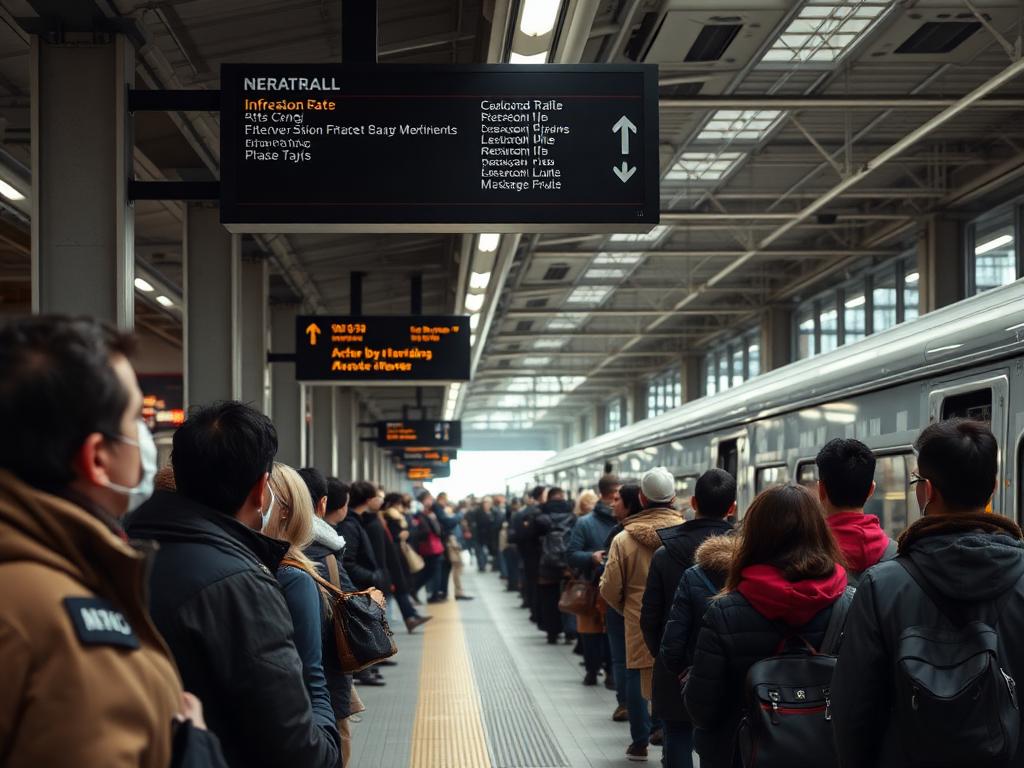
Candidate A — A busy train station
Need help? Show prompts (try describing with no help first)
- • What can you see?
- • What are the people probably waiting for?
- • How do they look?
- • Why might the board be important here?
- • How do you feel waiting at busy stations?

Candidate B — A waiter taking an order
Need help? Show prompts (try describing with no help first)
- • What can you see?
- • What is the waiter probably doing?
- • How do the customers seem to feel?
- • What might be difficult about this job?
- • Do you enjoy eating out in busy restaurants?
Useful phrases
- • In the photo I can see…
- • It looks as if…
- • They seem to be…
- • In the background…
- • I think they're probably…
Show model 1-minute description
In the first photo I can see a busy train station with a large board showing departure times. Several people are looking up at it, so it looks as if they're checking for a platform change or a delay. On the whole they seem a bit anxious, especially the woman checking her watch in the foreground.
Optional · Teacher-led
Teacher Activities
Run this lab with real audio pacing where possible — read scripts at natural speed, not slowly. The goal is to build tolerance for realistic listening speed, not comfort with slow, clear speech. ~42 min total
Keep it going · 10
Take-homeExtend it at home
Self-study — everything you need is included below. All four skills are covered so you keep the spiral going between lessons; pick the order that suits you.
PET Listening Part 1 mock — read the five mini-exchanges below and choose the correct picture-style answer for each.
Your response
0 words SavedMaterials included
Exchange 1
Exchange 2
Exchange 3
Attempt the task first, then check your answers.
PET Listening Part 3 mock — complete the notes from the short monologue below.
Your response
0 words SavedMaterials included
Monologue
Notes to complete
Trap-spotting drill — read the three mini-texts, underline the FIRST (wrong) idea and circle the corrected (right) idea.
Your response
0 words SavedMaterials included
Text 1
Text 2
Text 3
Attempt the task first, then check your answers.
Speaking Part 2 mock — describe the two lesson photos (station, restaurant) for 1 minute each, focusing on 'It looks as if…' and 'They seem to be…'.
Your response
0 words SavedMaterials included
Photos
Attempt the task first, then check your answers.
Wrap-up · 11
2–3 minWhat you can now do
- PET Listening plays twice: predict on play one, confirm/correct on play two.
- The FIRST idea mentioned is often a trap — the real answer follows a correction word.
- Correction words to listen for: however, but, actually, in the end.
- Note-taking should be fast and rough — jot down key words, not full sentences.
- Modals (might, should, could) usually signal opinion or possibility, not fact.
- Approximate numbers (roughly, about, around) are common in Part 3 note completion.
Need more practice?
Optional · your lesson progress stays the sameCareful listening: distractors
Practise this exam skill
Numbers, times and spelling
Practise this exam skill
Feelings, opinions and agreement
Practise this exam skill