
Exam Review Lab 09 —Speaking 2 & 3 clinic
Timed rehearsal for the photo long turn and the discussion task, marked against what examiners look for. Revision only · recycles Modules 07–08 — no new language.
PET parts in this lesson · mixed-skill spiral
Why this lesson now? Exam-focus hour attached to Module 08.
CEFR Pathway · You are here
Exam Boost · Performance Session
A progress checkpoint, not a test.
Recycle this phase's language through challenges, mini-tasks and longer speaking turns. Aim for fluency, not perfection — replay anything, skip nothing.
Get ready · 01
5 minGet talking — no pressure
What do you usually do in English when you don't know what to say next — pause, repeat a word, or say something in your own language in your head?
In pairs, agree on ONE thing you'll both try to do better today: speaking longer, using more linkers, or listening to your partner more.
Talk for exactly one minute about your morning, without stopping. Your partner times you.
Grammar recap · 02
8–10 minSpeculating language: looks like / seems / might be
Fact = present simple. Guess = 'It looks as if…', 'They seem to be…', 'It might be…'.
Speaking Part 2 rewards students who can move from description (fact) to speculation (guess) smoothly. Many B1 students only describe what's literally in the photo and never guess about it, which caps their score. The fix is a small toolkit of speculating language used automatically, without translating in your head.
→ In the photo I can see two people at a whiteboard. (fact)
→ It looks as if they're planning something together. (guess)
→ They seem to be enjoying the discussion. (guess about feeling)
→ This might be an office, or possibly a co-working space. (guess with alternatives)
→ I imagine they're colleagues rather than friends, because of how they're dressed. (guess + reason)
Challenge 1.___ they're discussing a new project.
Challenge 2.She ___ to be really enjoying herself.
Challenge 3.This ___ be a family holiday, or maybe just a day trip.
Challenge 4.I ___ they're planning a route on the map.
Challenge 5.They ___ colleagues, because they're both holding notebooks.
Build the sentence → spot the natural chunks → say it aloud → reply like a real conversation.
1.Rebuild the sentence — then say it aloud.
2.Rebuild the sentence — then say it aloud.
3.Rebuild the sentence — then say it aloud.
Quick check 1.Which sentence is a GUESS, not a fact?
Quick check 2.In Speaking Part 3, what should you do if your partner suggests an idea you disagree with?
Vocabulary recap · 03
5–7 minRecycle your toolkit
skilled / not skilled at something
What are you good at and what are you bad at?
used to introduce a surprising fact learned later
Tell a short story using 'it turns out'.
the level of formality expected for a piece of writing
Is an email to a friend usually formal or informal?
What to do
- 1.Revision only — every phrase here comes from Modules 7–8.
- 2.Match each one with its meaning.
Tap an item on the left, then tap its match on the right.
What to do
Sort the recycled phrases by the module where you first met them.
Activation · Personalise · Recycle
Reactivate Modules 7–8 language out loud — nothing new here, just faster recall.
Ask your partner
- Tell me one decision you made this week.
- Finish: 'I've lived here since…'
- What are you good at and what are you bad at?
"Finish: 'You can borrow it as long as…'"as long as
Which of these Modules 7–8 phrases do you still forget under exam pressure? Why?
Write 25–35 words about your English progress using BOTH recycled phrases.
Pronunciation polish · 04
3–4 minRising tone of voice for guesses, falling for facts
Facts fall. Guesses often rise slightly, then settle — it signals 'I'm not 100% sure'.
- • There are two people in the photo. (fall — fact)
- • It looks as if / they're planning something. (soft rise, then fall)
- • They might be / colleagues, or perhaps friends. (rise on options)
- • On balance, / I think it's an office. (fall — considered opinion)
Reading challenge · 05
8–10 minPET Reading Part 3 — Why examiners love speculation
Every year, PET examiners report the same pattern: many candidates can describe a photograph accurately but stop there. 'There is a table. There are three chairs. There is a window.' Technically correct, but it earns a lower mark than a shorter, less perfect answer that takes a risk.
The reason is simple. The PET Speaking test measures more than vocabulary — it measures how naturally you handle uncertainty, because real conversations are full of it. Native speakers rarely state facts one after another; they guess, soften, correct themselves, and move on. 'It looks like they're at a party — actually, maybe it's just a big family dinner.'
That single skill — speculating aloud, in real time, without stopping to translate — is what separates a confident B1 candidate from a hesitant one. It doesn't require rare grammar. It requires a small, reliable toolkit: 'it looks as if', 'they seem to be', 'I imagine', 'possibly'. Learn five phrases well, and use them constantly, rather than learning fifty and using none under pressure.
Challenge 1.What mistake do many candidates make in Speaking Part 2?
Challenge 2.According to the text, what does the Speaking test really measure?
Challenge 3.What does the writer recommend?
Q1.The writer says accurate description alone earns the top mark.
Q2.Native speakers often speculate and correct themselves in real conversation.
Q3.The writer recommends memorising fifty phrases.
What to do
PET Reading Part 1 — Read each notice and choose A, B or C.
Speaking test candidates: please wait here quietly until your name is called. Phones must be switched off, not silent.
1.What must candidates do?
SPEAKING TIPS
Remember: in Part 3, listen to your partner and respond to their idea before giving your own.
2.What does the poster remind candidates to do?
3.What is the teacher reminding the student to do?
4.What will candidate B do?
TODAY
Mock speaking tests running 10:00–12:00. Please arrive 10 minutes before your slot.
5.What should candidates do before their slot?
Listening challenge · 06
8–10 minPET Listening Part 3 — Two students prepare for their speaking mock
Listening audio
Tap play to listen. Replay as many times as you need.
Show transcript
Priya:Right, so we've got the photo task first, then the discussion. Are you nervous about the photo bit?
Tomas:A bit. I always run out of things to say after about thirty seconds. What do you do?
Priya:I try to move through it in stages — first the foreground, then the background, then I guess what's happening, then I say how I'd feel.
Tomas:That's clever. So it's like a checklist rather than just talking randomly.
Priya:Exactly. And for the discussion after, remember to build on what I say instead of just giving your own idea straight away.
Tomas:Good point. Last time I just said 'no, I think' and jumped straight to my opinion. I probably sounded rude.
Priya:A bit, yeah! Try something like 'That's a good point, and I'd add that…' It sounds much more natural, and examiners like it.
Tomas:Okay, let's practise. I'll do the photo first, then we'll do the discussion together.
Challenge 1.What problem does Tomas have with the photo task?
Challenge 2.What strategy does Priya use for the photo task?
Challenge 3.What mistake did Tomas make last time in the discussion?
What to do
Tick every phrase you hear in the dialogue.
Skills challenge · 07
5 minSpeaking Parts 2 & 3 — timing and structure
Part 2: describe, then guess, then react. Part 3: listen, build, then decide together.
Task
Both tasks fail for the same reason when students run out of structure: Part 2 candidates describe everything then freeze; Part 3 pairs either talk over each other or go silent waiting for the other to start. A simple structure prevents both.
Example
Part 3 prompt: 'Which of these activities would be best for a school trip?' → 'That's a good idea, and I'd add that the museum is also free for students. On balance, I think we should choose the museum because it's both cheaper and more educational.'
Writing challenge · 08
5 minShow what you can do
Q1.Type ONE word: 'It looks ___ if they're at a party.'
Q2.Type ONE word: 'They ___ to be having a great time.' (guess verb)
Q3.Type ONE word: 'In the ___, I can see two chairs.' (nearest the camera)
Q4.Type ONE word: 'On ___, I'd choose the second option.'
PET Writing Part 2 (article, ≈100 words). Prompt: 'Describe a photograph that means something to you and explain why.' Use ONE speculating phrase, ONE example linker.
Your writing draft
0 words SavedShow model answer & examiner comment
One of my favourite photos shows my grandfather teaching me to ride a bike. In the foreground, he's holding the back of the seat, and in the background you can just see our old garden. It looks as if I'm about to fall — my face is somewhere between excited and terrified. For example, I remember shouting 'don't let go!' about ten times. On balance, it's not a perfectly taken photo, but it captures a moment I still think about whenever I need courage to try something new.
Examiner comment
| 5 | All content points covered; consistent style; range of structures; minor errors only. |
| 3 | Content mostly covered; mostly suitable style; some range; errors don't stop the reader understanding. |
| 1 | Limited content; intrusive errors; very basic structures; under-length. |
What to do
- 1.PET Writing Part 1 — Reply to this email in about 100 words.
- 2.Cover ALL four notes.
Hi! I've got my Speaking test next week and I'm nervous, especially about describing photos. What do you usually say when you don't recognise something in a photo? Also, how do you make sure you talk for the full minute? And in the discussion part, what do you do if you disagree with your partner? Any tips would help so much! Sasha
Your reply must cover:
- Suggest a speculating phrase for unfamiliar objects
- Give a concrete structure for filling the full minute
- Give a polite way to disagree and build on an idea
- End with encouragement
Show model answer
Hi Sasha, don't worry, this happens to everyone! If you don't recognise something, just say 'it might be some kind of…' or 'I'm not sure what this is, but it looks like…' — examiners just want to hear you keep talking. To fill the minute, try describing the foreground, then the background, then guess what's happening, then say how you'd feel. For the discussion, if you disagree, say 'that's a good point, but I'd say…' rather than just saying no — it sounds much more natural. Good luck — you'll do brilliantly!
Communication lab · 09
10–15 minTalk it out
PET Speaking Part 3 — In pairs, 4 minutes. Discuss and decide: 'Your class can choose ONE activity for an end-of-term trip. Talk about the different activities and decide which would be best.' Build on your partner's ideas before disagreeing.
Examiner
"Now you have about three minutes to talk about this on your own. First, talk to each other about how enjoyable and useful each activity would be. Then decide which one would be best."
Talk together about
Which activity would be best for an end-of-term class trip?
Share opinions, agree and disagree — you do not have to talk only about yourself.
Ideas you could discuss
- A visit to a science museum
- A day at an outdoor adventure park
- A trip to the cinema
- A picnic and sports afternoon in the park
Round off the discussion
Together, agree on ONE activity and explain your final choice to the class in one sentence.
Useful discussion language
What to do
Choose the most natural way to respond in a Speaking Part 3 discussion.
- PartnerI think the science museum would be best because it's educational.
- Candidate_______________
- ExaminerSo, have you two come to a decision?
- Candidate_______________
What to do
PET Speaking Part 1 warm-up — 2 minutes per candidate before the main clinic tasks.
Phase 1 — short factual questions
1.Examiner: "What's your name and where are you from?"
2.Examiner: "Do you enjoy speaking English in class?"
Tip: Give a reason with 'because' or 'mainly'.
3.Examiner: "What did you do last weekend?"
Tip: Past simple + one detail.
4.Examiner: "Are you nervous about speaking exams?"
Tip: Yes/no + honest reason.
Phase 2 — extended question (aim for 3–5 sentences)
Examiner: "Tell me about a time you had to describe something to someone without preparing."
Tip: 25–35 seconds. What, when, how it went.
Show model extended answer
Once I had to describe a lost bag to airport staff without any warning. At first I panicked a bit, but then I just described it piece by piece — colour, size, what was inside — and it turned out fine. It taught me that speaking calmly, one detail at a time, is much more useful than trying to say everything at once.
What to do
- 1.PET Speaking Part 2 — 1 minute per candidate.
- 2.Use the checklist: foreground → background → guess → reaction.
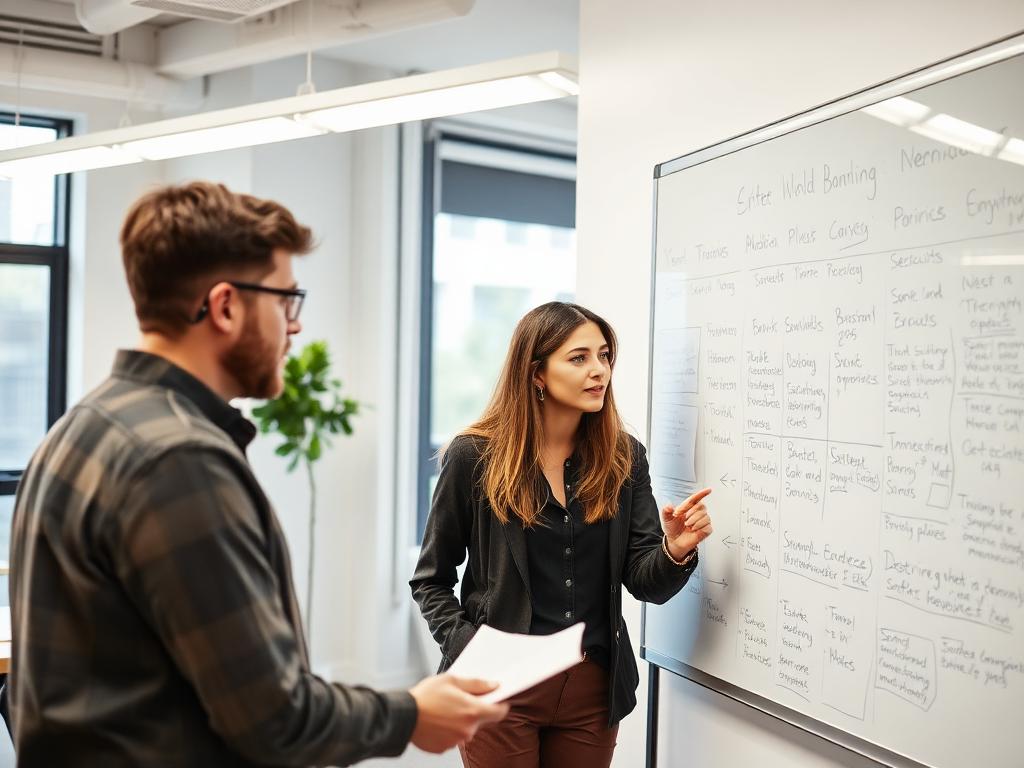
Candidate A — Colleagues at a whiteboard
Need help? Show prompts (try describing with no help first)
- • What can you see in the foreground?
- • What's in the background?
- • What do you think they're planning?
- • How do they seem to feel?
- • Do you enjoy working with other people on ideas?
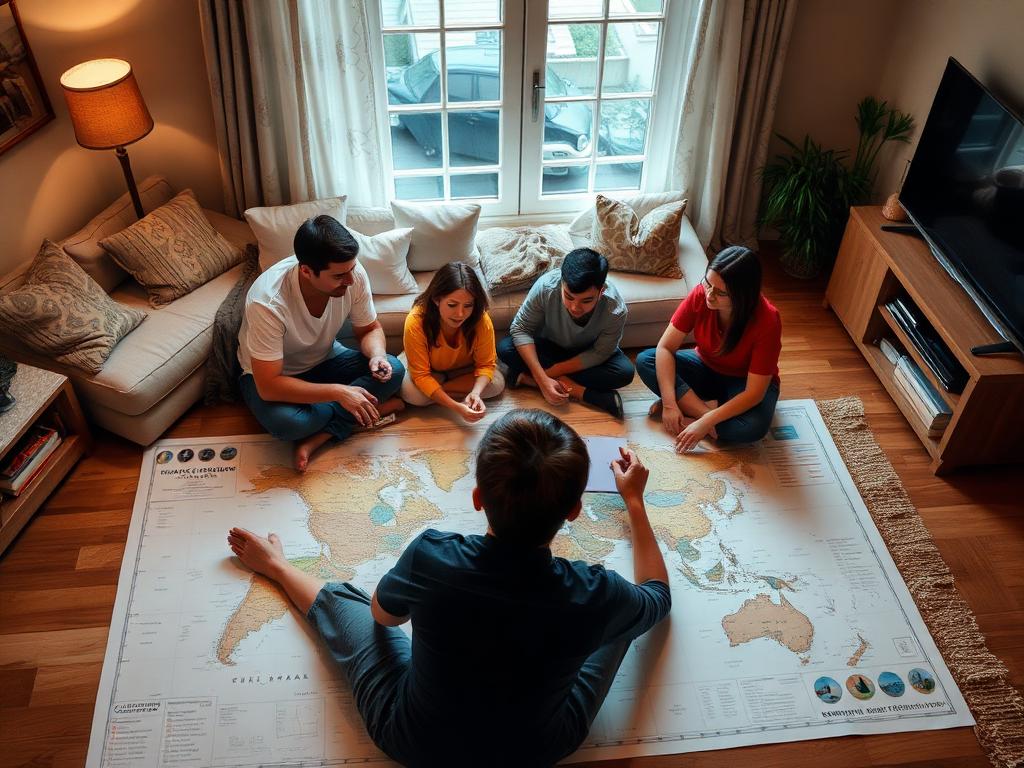
Candidate B — A family planning a trip
Need help? Show prompts (try describing with no help first)
- • What can you see?
- • Where are they?
- • What are they probably deciding?
- • How do they look?
- • Does your family plan trips together?
Useful phrases
- • In the foreground I can see…
- • In the background…
- • It looks as if…
- • They seem to be…
- • I imagine…
Show model 1-minute description
In the foreground I can see two colleagues standing at a whiteboard covered in notes and diagrams. One of them is pointing at something while the other listens. In the background there's a large office window and some plants. It looks as if they're planning a new project together — they both seem really focused. On balance, I imagine this is an important meeting, because they've got so many notes on the board already.
Optional · Teacher-led
Teacher Activities
Run this as a rapid-fire clinic: short bursts, immediate feedback, lots of repetition on the same two tasks rather than covering new ground. Use a visible timer for both Part 2 and Part 3 tasks. ~42 min total
Keep it going · 10
Take-homeExtend it at home
Self-study — everything you need is included below. All four skills are covered so you keep the spiral going between lessons; pick the order that suits you.
Photo description drill — describe THREE photos from your own camera roll, 60 seconds each, using the four-stage checklist.
Your response
0 words SavedMaterials included
Checklist
Attempt the task first, then check your answers.
Discussion planning sheet — prepare answers for a Speaking Part 3 topic on your own.
Your response
0 words SavedMaterials included
Topic
Task
Attempt the task first, then check your answers.
Vocabulary self-test — complete the sentences using the Speaking 2/3 phrase bank, then check answers.
Your response
0 words SavedMaterials included
Sentences to complete
Attempt the task first, then check your answers.
Listening re-read — read the Priya/Tomas dialogue aloud twice, focusing on rising tone of voice for guesses.
Your response
0 words SavedMaterials included
Dialogue
Focus
Attempt the task first, then check your answers.
Wrap-up · 11
2–3 minWhat you can now do
- Speaking Part 2 = describe, then guess, then react — not just a list of facts.
- Use a reliable toolkit: it looks as if / they seem to be / it might be.
- Speaking Part 3 = listen, build on your partner's idea, then agree on a decision.
- 'That's a good point, and I'd add…' sounds far more natural than a flat disagreement.
- A four-stage checklist (foreground/background/guess/reaction) fills the full minute reliably.
- Examiners reward natural uncertainty more than a perfectly memorised description.
Need more practice?
Optional · your lesson progress stays the sameFuture plans and conditions
Practise this exam skill
Short notices and messages
Practise this exam skill
Numbers, times and spelling
Practise this exam skill